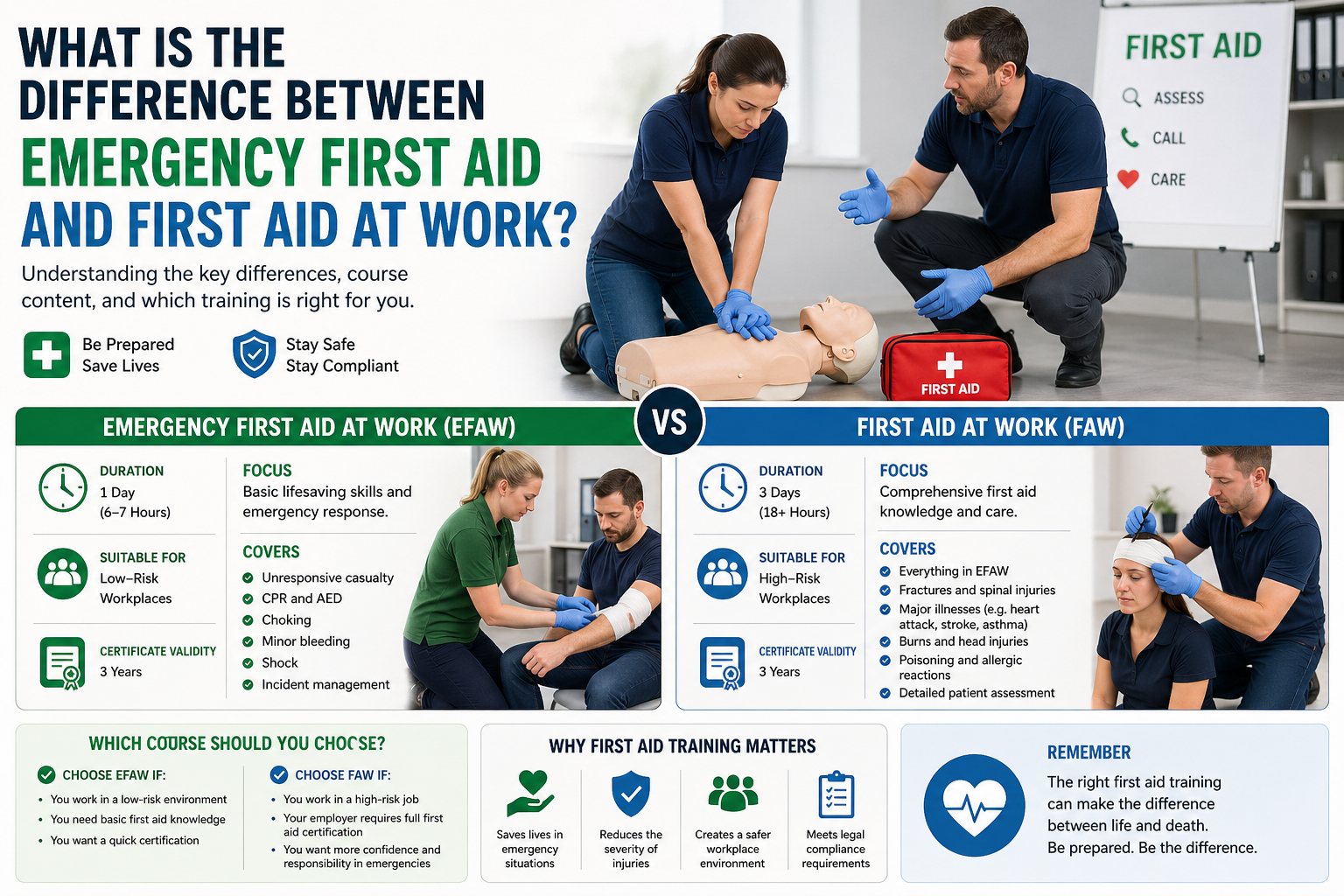
When it comes to workplace safety and compliance in the UK, first aid training is not just a recommendation; it’s often a legal requirement. However, many people get confused between two of the most common qualifications: Emergency First Aid at Work (EFAW) and First Aid at Work (FAW). While both courses aim to prepare individuals to respond to medical emergencies, they differ significantly in terms of depth, duration, coverage, and workplace suitability.
This guide breaks down those differences clearly, helping employers, employees, and job seekers choose the right emergency first aid training course for their needs.
Emergency First Aid at Work (EFAW)
Emergency First Aid at Work is a basic, entry-level course designed to equip learners with the essential skills needed to respond to life-threatening situations.
Key Features of EFAW:
- Typically a 1-day course (around 6–7 hours)
- Focuses on immediate response techniques
- Suitable for low-risk workplaces
- Covers core lifesaving skills
What You Learn in EFAW:
Participants are trained to handle:
- Unresponsive casualties
- CPR (Cardiopulmonary Resuscitation)
- Choking
- Minor bleeding and shock
- Basic incident management
This course is ideal for environments like small offices, retail shops, or businesses with minimal health risks.
Understanding First Aid at Work (FAW)
First Aid at Work is a more comprehensive, in-depth training programme designed for higher-risk workplaces or organisations that require a fully trained first aider on-site.
Key Features of FAW:
- Typically a 3-day course (18+ hours of training)
- Covers a wide range of medical scenarios
- Suitable for high-risk environments
- Provides deeper practical and theoretical knowledge
What You Learn in FAW:
In addition to everything covered in EFAW, FAW includes:
- Fractures and spinal injuries
- Major illnesses (heart attack, stroke, asthma)
- Head injuries and burns
- Poisoning and allergic reactions
- Detailed patient assessment
This course is essential for workplaces such as construction sites, warehouses, factories, and security roles.
Key Differences Between EFAW and FAW
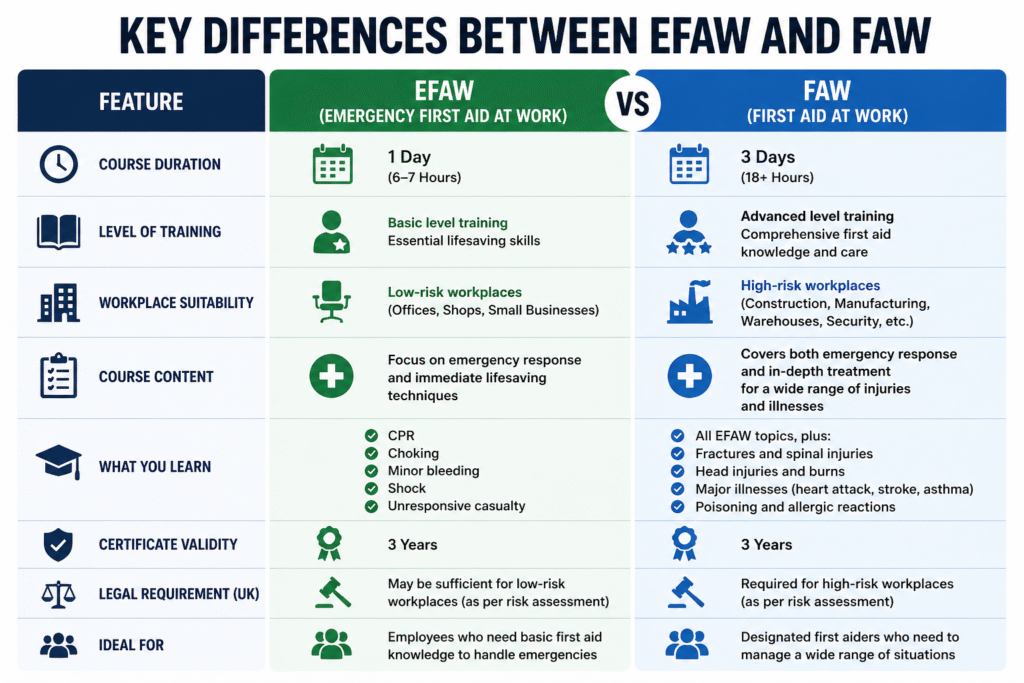
Key Differences Between EFAW and FAW: EFAW is a one-day basic course for low-risk workplaces, while FAW is a comprehensive three-day training designed for high-risk environments.
1. Course Duration
- EFAW: 1 day
- FAW: 3 days
FAW provides more time for in-depth learning and hands-on practice.
2. Level of Training
- EFAW: Basic lifesaving skills
- FAW: Advanced and comprehensive first aid knowledge
3. Workplace Suitability
- EFAW: Low-risk environments (offices, shops)
- FAW: High-risk environments (construction, industrial sites)
4. Course Content
- EFAW: Focuses on emergency response
- FAW: Covers both emergency and ongoing care
5. Legal Requirements
UK employers must conduct a risk assessment to determine which course is appropriate.
- Low-risk workplaces may only need EFAW-trained staff
- Higher-risk workplaces often require at least one FAW-qualified first-aider
Which Course Should You Choose?
Choosing between EFAW and FAW depends on several factors:
Choose EFAW if:
- You work in a low-risk environment
- You need basic first aid knowledge
- You want a quick certification
Choose FAW if:
- You work in a high-risk job
- Your employer requires full first aid certification
- You want more confidence and responsibility in emergencies
Why First Aid Training Matters
Regardless of the course type, first aid training plays a critical role in:
- Saving lives in emergency situations
- Reducing the severity of injuries
- Creating a safer workplace
- Meeting legal compliance requirements
For security professionals, first aid training is often mandatory, especially when applying for licences or working in public-facing roles.
Certification and Validity
Both EFAW and FAW certificates are:
- Valid for 3 years
- Issued by approved training providers
- Recommended to be refreshed annually with short updates
Can You Upgrade from EFAW to FAW?
Yes. Many learners start with EFAW and later progress to FAW as their job role evolves. This is common in industries like:
- Security
- Construction
- Facilities management
Upgrading ensures you stay competitive and better prepared for emergencies.
Common Misconceptions
“EFAW is enough for all workplaces”
Not true. High-risk workplaces require more comprehensive coverage.
“FAW is only for medical professionals”
Incorrect. Anyone can take FAW training—no prior experience needed.
“Online courses are always valid”
Not always. Practical, in-person assessment is usually required for full certification in the UK.
Final Thoughts
Understanding the difference between Emergency First Aid at Work and First Aid at Work is essential for both compliance and safety. While EFAW provides a solid foundation for handling emergencies, FAW offers a deeper level of training suited for more demanding environments.
If you’re unsure which course to take, consider your workplace risk level, job role, and future career goals. Investing in the right training not only enhances your skills but could also save lives.
Frequently Asked Questions (FAQs)
1. What is the main difference between EFAW and FAW?
The main difference is the depth of training and duration. EFAW is a 1-day basic course, while FAW is a 3-day comprehensive course.
2. Is emergency first aid at work enough for an SIA licence?
Yes, in many cases, EFAW meets the requirement for SIA training, but it must include CPR and AED training.
3. How long does a First Aid at Work certificate last?
Both EFAW and FAW certificates are valid for 3 years.
4. Can I take First Aid at Work without doing EFAW first?
Yes, you can directly enrol in FAW without completing EFAW.
5. Which course is better for beginners?
EFAW is better for beginners who want quick, basic knowledge. FAW is ideal for those seeking more in-depth training.
6. Is online first aid training valid in the UK?
Partially. Theory can be done online, but practical assessment must be completed in person.
7. Do all workplaces need a trained first aider?
Yes, UK law requires employers to ensure adequate first aid provision based on risk assessment.